
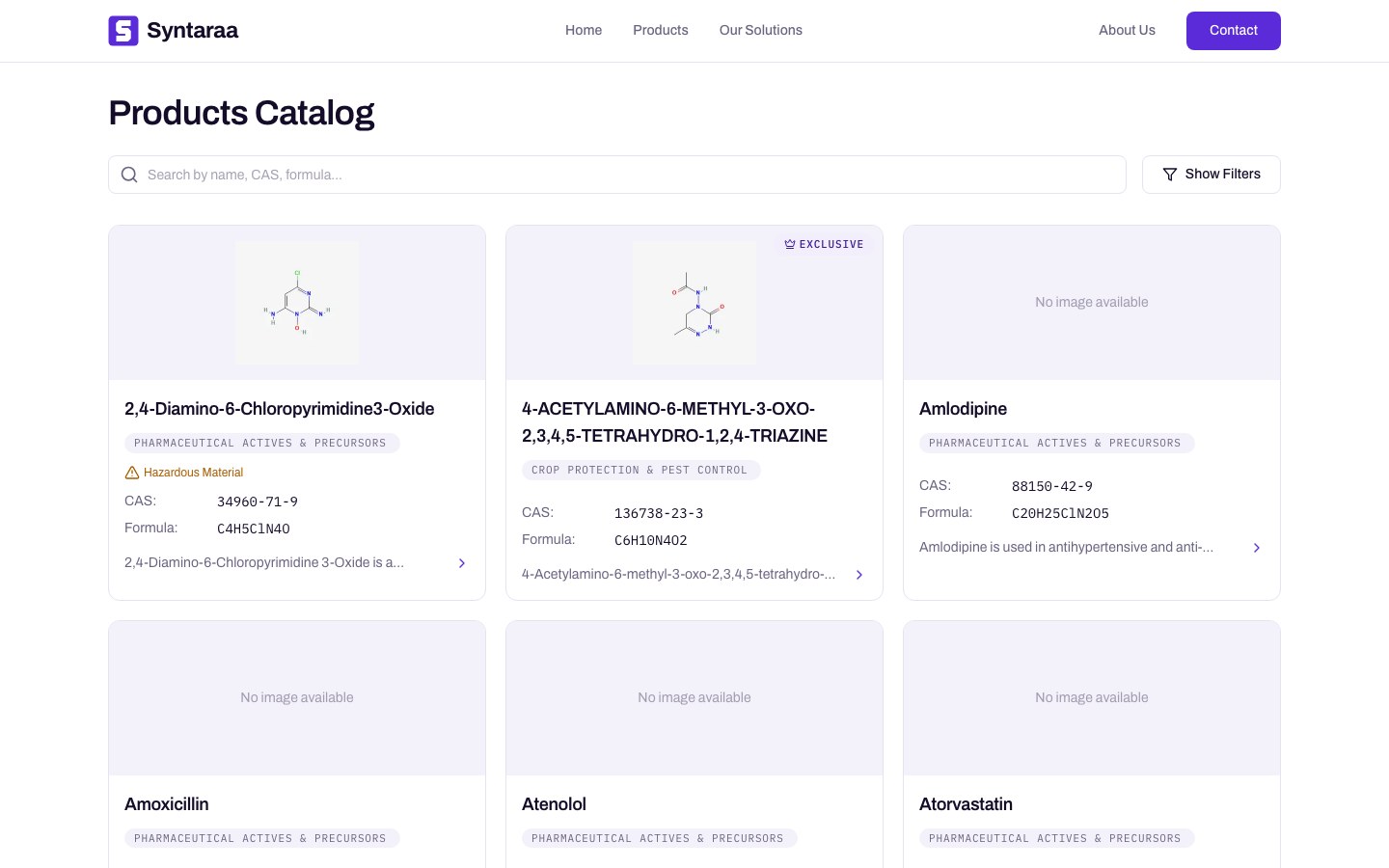

A public trade workflow platform built for my flatmate's dad's import-export business: catalogues, enquiries, supplier and customer workflows, documents, and AI-assisted business tools.
Context
Syntara is a public B2B platform I built to support my flatmate's dad's import-export business in chemical and pharmaceutical trade. Unlike my smaller personal tools, it sits inside a formal business domain where trust, documentation, and operational clarity matter as much as the interface.
Problem
Import–export operations run on dense product catalogues, customer enquiries, supplier coordination, and document-heavy workflows. Before Syntara, much of that work moved through fragmented files, messages, and memory. Operators needed to move quickly between product specs, compliance context, and the next operational step, without a generic marketplace shell getting in the way.
Product
Syntara covers the core trade workflow:
- Import and export workflow surfaces shaped around how the business actually operates.
- Catalogue management for structured product discovery and product data.
- Enquiry handling and customer workflow tools.
- Supplier and customer relationship views.
- Document management for trade and operational paperwork.
- Admin surfaces for managing trade data and business operations.
- AI-assisted business tools for working with complex product and trade information.
System Architecture
Syntara spans a public business-facing surface and an operational backend shaped around import-export workflows. The core design problem is information architecture: simplifying complexity in a high-trust domain without making the product feel shallow or unreliable.
The platform separates catalogue and workflow presentation (what operators and customers see) from the underlying trade data model (products, suppliers, documents, enquiries) so each layer can evolve as the business grows into the system.
Current State
Syntara is still evolving as the business grows into it, but it already reflects how I approach domain-heavy B2B work: start from a real operator, map the workflow honestly, then build surfaces that respect how people actually run the business.